

Best Products for Acne Marks in Bangladesh: Complete Guide
Acne marks can remain after a breakout has disappeared, making the skin look uneven even when there are no active pimples. The right approach depends on whether you are dealing with a flat dark mark, redness after acne, active breakouts, or a true acne scar.
For flat post-acne marks, skincare products containing ingredients such as niacinamide, azelaic acid, tranexamic acid and alpha arbutin may be relevant. Daily sunscreen is also an important part of a routine because UV exposure can make uneven pigmentation more noticeable.
What Are Acne Marks?
“Acne marks” can refer to several different changes that remain after a breakout.
The most common concern is a flat area of discoloration where a previous pimple or inflamed spot existed. These marks may appear darker than the surrounding skin and can take time to become less noticeable.
Some people also experience red or pink marks after acne. These are not the same as dark brown or greyish pigmentation, so choosing a product should start with identifying what type of mark you have.
Active Acne vs Acne Marks
This distinction is important.
Active acne refers to current pimples, clogged pores, blackheads, whiteheads or inflamed breakouts.
Post-acne marks are changes left behind after the original breakout has settled.
A product designed primarily for active acne may not be the most appropriate choice for a flat dark mark.
BeautyBellBD already has a separate acne-focused category containing products such as salicylic-acid and acne-care formulas. Acne-spot-treatment
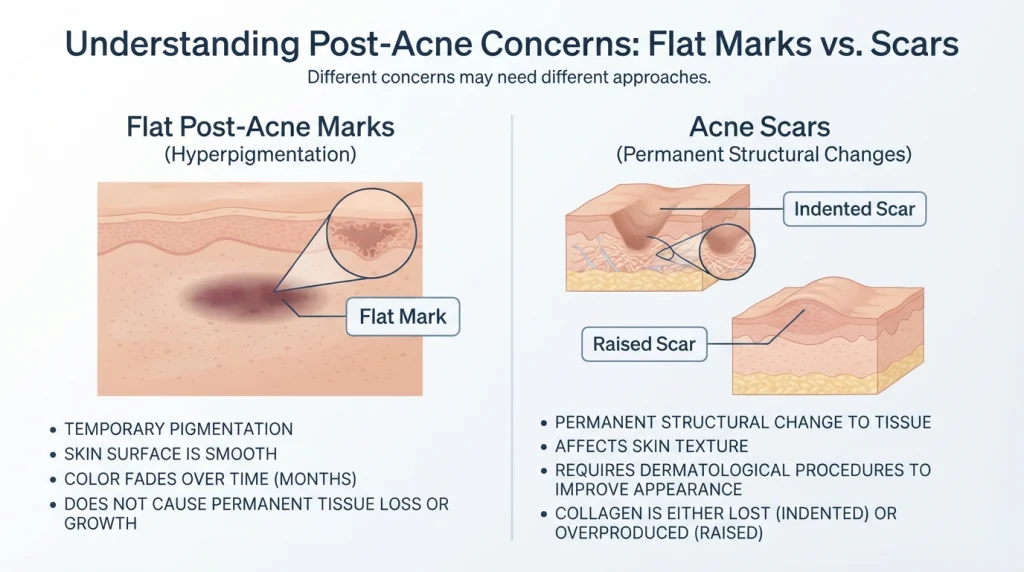
Acne Marks vs Acne Scars: What’s the Difference?
Not every post-acne change is a “scar.”
| Concern | Typical appearance | Main skincare focus |
|---|---|---|
| Dark post-acne mark | Flat brown/dark area | Pigmentation-focused skincare + sunscreen |
| Red post-acne mark | Flat red/pink area | Gentle routine + sun protection |
| Atrophic acne scar | Indented skin | Cosmetic skincare may have limited effect |
| Raised acne scar | Raised or thickened area | Professional assessment may be appropriate |
| Active acne | Current pimple/bump | Acne-focused treatment |
This distinction matters because a serum may be appropriate for the appearance of discoloration, but skincare should not be presented as a guaranteed solution for structural acne scarring.If a flat dark spot remains after acne clears, it may be post-inflammatory hyperpigmentation (PIH) rather than a true acne scar. The American Academy of Dermatology explains that flat discoloration after acne is often PIH, while structural acne scars create changes in skin texture. American Academy of Dermatology — Acne Scars Overview
What Ingredients Should You Look For?
There is no single “best” ingredient for every acne mark.
Instead, look at the type of concern and choose a formulation that fits your skin.
For post-inflammatory hyperpigmentation, dermatology resources discuss ingredients such as azelaic acid, vitamin C, arbutin and niacinamide among topical options. DermNet — Post-inflammatory Hyperpigmentation
Niacinamide
Niacinamide is commonly used in skincare for uneven-looking skin tone, blemish-prone skin and barrier-supporting routines.
It can be a useful choice for people who want an ingredient that fits into a broader everyday routine rather than using a highly targeted treatment.
For example, BeautyBellBD currently lists Minimalist Niacinamide 05% Face Serum 30ml, formulated with 5% niacinamide alongside ingredients such as bifida ferment lysate, oat extract and hyaluronic acid. Minimalist-niacinamide
Azelaic Acid
Azelaic acid is another ingredient worth considering when acne and post-acne discoloration overlap.
It is particularly interesting for people who still experience occasional breakouts while also being concerned about marks left behind by previous acne.
BeautyBellBD currently carries products such as ANUA Azelaic Acid 10 Hyaluron Redness Soothing Serum and Cos De BAHA Azelaic Acid 10 Serum. Beauty Bell
Tranexamic Acid
Tranexamic acid is frequently found in pigmentation-focused skincare.
It may be particularly relevant when your main concern is flat dark spots and uneven-looking skin tone rather than active acne.
BeautyBellBD lists Minimalist 03% Tranexamic Face Serum, a 30ml serum featuring 3% tranexamic acid.
BeautyBellBD also carries ANUA Niacinamide 10% + TXA 4% Dark Spot Correcting Glow Serum, which combines tranexamic acid with niacinamide and arbutin.
Alpha Arbutin
Alpha arbutin is another ingredient commonly found in pigmentation-focused skincare.
It can make sense for readers whose primary concern is dark spots rather than active acne.
One relevant BeautyBellBD product is Deconstruct Clearing Serum With 2% Alpha Arbutin + 5% Niacinamide, which is listed for concerns including dark spots, acne marks and uneven-looking skin tone. Beauty Bell
Vitamin C
Vitamin C derivatives are commonly included in brightening-focused skincare.
They may appeal to shoppers who want a broader brightening routine rather than a single-ingredient treatment.
However, formulation matters. Two products labelled as “vitamin C serums” may have very different formulas, textures and supporting ingredients.
Best Types of Products for Acne Marks
Instead of searching only for one “best acne marks serum,” think about the role each product plays.
| Product type | Best suited to | What to consider |
|---|---|---|
| Niacinamide serum | Everyday blemish + tone routine | Concentration and overall formula |
| Azelaic acid serum | Acne + marks combination | Skin tolerance |
| Tranexamic acid serum | Dark spot-focused routine | Other active ingredients |
| Alpha arbutin serum | Uneven tone/dark spots | Complete formulation |
| Vitamin C serum | Brightening-focused routine | Type of vitamin C |
| Sunscreen | Daily protection | Broad-spectrum protection and comfortable texture |
How to Choose Products Based on Your Skin Concern
If You Mainly Have Dark Marks After Acne
Look for a routine centred around pigmentation-friendly ingredients such as:
- tranexamic acid
- alpha arbutin
- niacinamide
- suitable vitamin C formulations
A lightweight serum can be useful if you already have a simple cleanser-moisturizer routine.
If You Still Get Acne and Have Marks
Your routine may need to address both concerns, rather than treating every dark mark with a strong brightening product.
Azelaic acid can be an interesting ingredient to investigate because it is used in skincare routines involving both acne-related concerns and uneven pigmentation.
BeautyBellBD’s Cos De BAHA Azelaic Acid 10 Serum is one example currently listed for this type of concern. Beauty Bell
If Your Skin Is Oily or Combination
Texture becomes especially important.
A lightweight serum that layers comfortably may be easier to maintain than a heavy formula.
Also remember that oily skin can still become dehydrated. Avoid turning an acne-mark routine into an aggressive routine full of exfoliating acids.
If Your Skin Is Sensitive
Start with a simpler routine.
Rather than introducing several active ingredients simultaneously:
- Choose one active.
- Patch test where appropriate.
- Introduce it gradually.
- Monitor how your skin responds.
- Avoid adding several new treatments at the same time.
If irritation occurs, simplify the routine rather than adding another treatment to compensate.
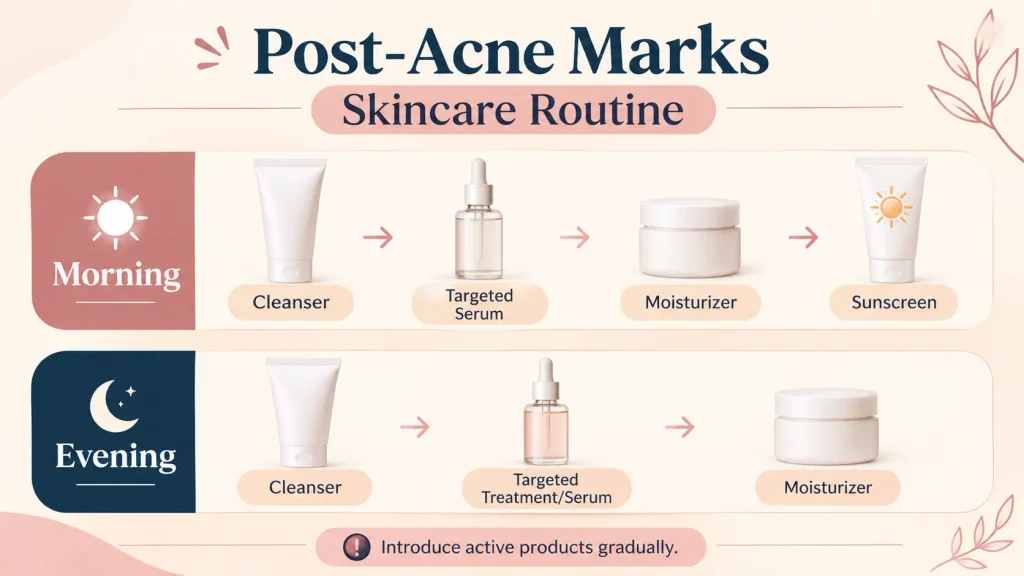
Acne Marks Skincare Routine
A simple routine is often easier to maintain than an overloaded one.
Morning
Gentle cleanser → targeted serum → moisturizer if needed → sunscreen
The exact serum depends on your concern.
For example, someone focused mainly on dark spots may choose a pigmentation-focused serum, while someone concerned about both acne and marks may consider a different active.
Night
Cleanser → targeted treatment/serum → moisturizer
Do not assume that using more active products will make marks disappear faster.
Consistency and skin tolerance matter more than building the longest possible routine.
Why Sunscreen Matters for Acne Marks
Sunscreen should not be treated as an optional final step when pigmentation is your main concern.
Sun exposure can make uneven pigmentation more noticeable and can work against a routine designed to improve the appearance of dark spots.
This is why a good acne-mark routine should not consist only of a serum.
A practical routine is usually:
Cleanse → target the concern → moisturize → protect from the sun
For daytime, use a broad-spectrum sunscreen according to its directions and reapply as appropriate for your exposure.
Products for Acne Marks Available at BeautyBellBD
After understanding the ingredients, you can compare actual products based on your concern rather than simply choosing the product with the strongest-sounding claim.
1. Minimalist 03% Tranexamic Face Serum
May suit: Readers primarily concerned with dark spots, uneven-looking skin tone and post-blemish marks.
Purpose: A tranexamic-acid-focused serum for pigmentation-oriented routines.
Why it is relevant: The current BeautyBellBD listing identifies 3% tranexamic acid as the key ingredient and describes the product as a lightweight serum for uneven-looking skin tone, dark spots and post-blemish marks.
Product: Minimalist 03% Tranexamic Face Serum
2. ANUA Niacinamide 10% + TXA 4% Dark Spot Correcting Glow Serum
May suit: Readers looking for a combination formula focused on dark spots and uneven-looking tone.
Purpose: Combines niacinamide, tranexamic acid and arbutin in one serum.
Why it is relevant: BeautyBellBD lists the product as a lightweight serum containing 10% niacinamide, 4% tranexamic acid and 2% arbutin.
Product: ANUA Niacinamide 10% + TXA 4% Serum
3. Deconstruct Clearing Serum With 2% Alpha Arbutin + 5% Niacinamide
May suit: Readers focused on dark spots, post-acne marks and uneven-looking skin tone.
Purpose: Combines alpha arbutin with niacinamide in a lightweight water-based serum.
Why it is relevant: The current product listing specifically identifies dark spots, acne marks and uneven skin tone among its target concerns. Beauty Bell
Product: Deconstruct Clearing Serum
4. Cos De BAHA Azelaic Acid 10 Serum
May suit: Readers who have acne-prone skin alongside concerns about post-acne marks.
Purpose: An azelaic-acid serum that can fit a routine where acne and discoloration are both relevant.
Why it is relevant: The current BeautyBellBD listing identifies 10% azelaic acid and also lists niacinamide, panthenol and sodium hyaluronate among the ingredients. Beauty Bell
Product: Cos De BAHA Azelaic Acid 10 Serum
5. Fixderma Acne Defence Face Serum
May suit: Readers whose main concern is ongoing acne with associated blemishes rather than only old dark marks.
Purpose: Acne-focused skincare.
Why it is relevant: BeautyBellBD lists this serum with salicylic acid, azelaic acid, mandelic acid and niacinamide and positions it for acne-prone skin and breakouts. Beauty Bell
Product: Fixderma Acne Defence Face Serum
Important: This should not replace the separate acne-serum article. Here it functions as an option for readers whose “marks” concern is accompanied by active acne.
Which Product Type Should You Choose?
A useful decision framework is:
| Your main concern | Start by exploring |
|---|---|
| Mostly flat dark marks | Tranexamic acid / alpha arbutin |
| Dark marks + uneven tone | Niacinamide + TXA / alpha arbutin |
| Acne + post-acne marks | Azelaic acid |
| Active acne is still frequent | Acne-focused treatment |
| General brightening concern | Vitamin C / niacinamide |
| Pigmentation concern | Targeted serum + sunscreen |
This is a selection framework, not a ranking of products. Skin tolerance, the complete formula and the nature of the mark all matter.
Common Mistakes to Avoid
1. Treating Every Mark Like Active Acne
A flat dark spot is not the same thing as a fresh pimple.
Using strong acne treatments unnecessarily can make a routine more complicated and potentially irritating.
2. Using Too Many Actives
Combining multiple acids, retinoids, brightening serums and acne treatments at once can make it difficult to know what is working—or causing irritation.
Introduce products one at a time.
3. Skipping Sunscreen
A pigmentation-focused routine without daytime sun protection is incomplete.
4. Picking a Product Only Because It Has a Higher Percentage
Higher concentration does not automatically mean a product is better for your skin.
Look at the complete formulation, supporting ingredients, texture and your own tolerance.
5. Expecting a Serum to Remove Acne Scars
Topical skincare can be useful for the appearance of some discoloration, but indented or raised scars are different from flat post-acne marks.
How Long Does It Take for Acne Marks to Improve?
There is no universal timeline.
It depends on:
- the type of mark
- how deep or persistent the discoloration is
- skin type
- product consistency
- sun exposure
- whether new acne continues
- how well the skin tolerates the routine
Avoid product claims promising that acne marks will disappear within a fixed number of days.
When Should You Consider Professional Advice?
Consider consulting a dermatologist if you have:
- painful or severe acne
- deep or recurring cystic breakouts
- significant scarring
- persistent pigmentation that concerns you
- worsening irritation
- uncertainty about whether a mark is actually a scar
Skincare products should not be presented as substitutes for medical diagnosis or treatment.
FAQ
What are the best products for acne marks in Bangladesh?
The best product depends on whether the concern is a flat dark mark, redness, active acne or scarring. For dark spots, products containing ingredients such as tranexamic acid, alpha arbutin or niacinamide may be relevant, while azelaic acid can be considered when acne and marks overlap.
Which serum is best for post-acne marks?
There is no single serum that is best for everyone. Tranexamic-acid, alpha-arbutin, niacinamide and azelaic-acid formulas can all have different roles depending on the skin concern and formulation.
Is azelaic acid good for acne marks?
Azelaic acid is commonly used in skincare routines involving acne and uneven pigmentation, so it may be relevant when active acne and post-acne marks occur together.
Can niacinamide help with acne marks?
Niacinamide is commonly included in skincare routines for blemish-prone skin and uneven-looking skin tone. Its suitability depends on the complete formula and your skin’s tolerance.
Is tranexamic acid suitable for acne marks?
Tranexamic acid is commonly used in pigmentation-focused skincare and can be considered when the main concern is flat dark spots or uneven-looking skin tone after acne.
Should I use sunscreen for acne marks?
Yes. Daily sun protection is an important part of a pigmentation-focused skincare routine because UV exposure can make uneven pigmentation more noticeable.
Can acne marks and acne scars be treated the same way?
No. Flat discoloration and structural scars are different concerns. A topical skincare product may be relevant to discoloration but should not be presented as a guaranteed treatment for indented or raised scars.
How many acne-mark products should I use at once?
Start with a simple routine and introduce one active product at a time. Using multiple strong actives simultaneously can increase complexity and irritation risk.
Should I choose a higher-strength serum for faster results?
Not necessarily. A higher concentration does not automatically mean better results or better tolerance. The complete formula and your skin’s response are more important.
Final Takeaway
The best products for acne marks in Bangladesh are not necessarily the products with the strongest concentration or the most marketing claims.
First identify whether you are dealing with flat post-acne discoloration, active acne, redness or structural acne scars. Then choose products based on the actual concern.
For pigmentation-focused routines, ingredients such as tranexamic acid, alpha arbutin and niacinamide may be relevant. If acne and marks occur together, azelaic acid may be another option to consider. Whatever active you choose, keep the overall routine simple and include daytime sunscreen.
Acne marks can be frustrating, but choosing the right product starts with identifying what type of mark you actually have. Flat post-acne dark spots, active acne, redness and structural acne scars are different concerns and should not be treated as interchangeable.
For dark-spot-focused routines, ingredients such as tranexamic acid, alpha arbutin and niacinamide may be worth considering. If acne and post-acne marks occur together, azelaic acid can also be relevant. Most importantly, keep your routine simple, introduce active products gradually and use daytime sunscreen consistently.
BeautyBellBD offers several products that fit these different needs, including Minimalist Tranexamic Face Serum, ANUA Niacinamide + TXA Serum, Deconstruct Alpha Arbutin + Niacinamide Serum and Cos De BAHA Azelaic Acid 10 Serum. The best choice is the one that matches your specific concern, skin tolerance and overall routine—not simply the product with the strongest marketing claim.



 English
 Bengali