

The Complete Hair Color Guide: How to Choose the Right Hair Color for You
Changing your hair color can completely change the way your overall look feels. You might want a subtle brown that looks natural, a rich burgundy for a noticeable change, a cool ash blonde, or simply a deeper version of your natural color.
But how do you know which shade is actually right for you?
The easiest approach is not to start with a specific brand or box. Start with your starting hair color, skin tone, undertone and desired result.
How Do You Choose the Right Hair Color?
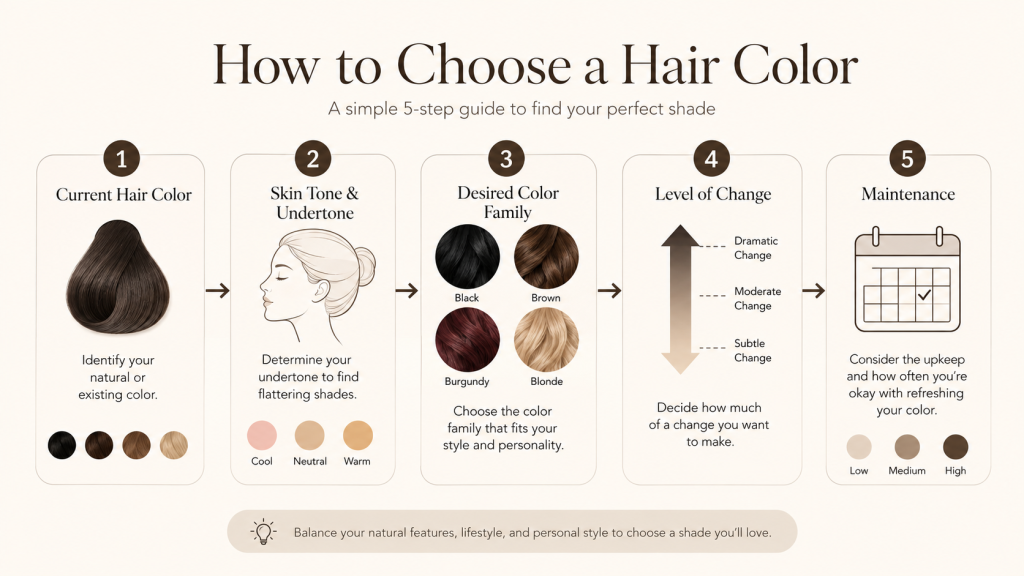
The right hair color is usually the one that works with your natural features and gives you the level of change you actually want. Start by identifying your skin undertone—warm, cool or neutral—then consider your natural hair color, the shade family you prefer and whether your desired result requires lightening or bleaching. Always check the manufacturer’s shade information and instructions before use.
Skin tone and undertone are related but different. Skin tone describes the surface depth of your complexion, while undertone refers to the underlying warm, cool or neutral cast.
What Is a Hair Color Guide?
A hair color guide is essentially a decision-making tool.
Instead of asking:
“Which hair color is the most beautiful?”
ask:
“Which shade fits my current hair, complexion, desired result and maintenance preferences?”
There is no single hair color that is universally best for every person.
Even professional colourists use multiple factors when assessing a color choice. Recent L’Oréal Professionnel guidance, for example, recommends considering skin tone, undertone, existing hair and the desired result rather than relying on a single rule.
Understand Your Natural Hair Color First
Before choosing a dye, look at your current hair rather than only looking at the color printed on the box.
Your starting point matters because the same dye can produce different-looking results on different bases.
For example:
- Naturally dark hair may show a brown shade more subtly.
- A medium-brown base may reveal more visible warmth.
- Light hair generally gives more flexibility with blonde and pastel directions.
- Previously colored hair may behave differently from virgin hair.
This is particularly important when choosing significantly lighter shades.
The product page for BeautyBellBD’s L’Oreal Hair Color Preference 7.1 Ash Blonde, for example, specifically notes that starting hair color affects the final result and that significantly darker hair may need lightening or professional color work to achieve a much lighter blonde appearance.
A simple starting-color rule
Before buying a shade, ask:
“What color is my hair now?”
Then ask:
“How many levels lighter or darker am I trying to go?”
That two-step check can prevent unrealistic expectations.
Identify Your Skin Tone
Skin tone and undertone are not the same thing.
Skin tone describes the visible depth of your complexion. It can broadly range from fair to medium to deep, with many variations in between.
Your skin undertone is the underlying warm, cool or neutral quality beneath that surface tone. Garnier’s current guide similarly separates skin tone from undertone and describes warm, cool and neutral undertones.
Why skin tone matters
Skin tone can help you understand how much contrast you want.
For example, someone with a lighter complexion may prefer either a soft close-to-tone shade or a deliberate high-contrast color. Someone with a deeper complexion might prefer rich browns, cool dark shades, burgundy or other highly saturated tones.
The key point is that skin tone should guide your options, not restrict them.
Find Your Skin Undertone

Undertone is one of the most useful concepts when choosing a hair color.
The three broad categories are:
| Undertone | Common visual direction | Hair-color families to explore |
| Warm | Golden, peachy or yellowish | Golden brown, caramel, copper, warm chocolate |
| Cool | Pink, bluish or rosy | Ash brown, ash blonde, cool brunette, some violet-based shades |
| Neutral | Combination of warm and cool characteristics | Wide range of warm, cool and neutral shades |
One common at-home clue is the appearance of veins on the wrist in natural light, although this should be treated as a guide rather than a perfect diagnostic. Garnier and L’Oréal Professionnel both currently discuss warm, cool and neutral undertones when helping consumers choose hair color.
A better approach than relying on one test
Look at several things together:
- how your skin looks in natural daylight
- whether warm or cool jewelry tends to complement you
- how your complexion reacts beside gold, silver, cream and pure white
- which clothing colors tend to look harmonious
No single test should determine your entire hair-color decision.
Match Hair Colors to Your Undertone
This is where your hair color guide becomes practical.
Warm undertones
Warm undertones can work well with shades that have visible warmth, such as:
- caramel brown
- golden brown
- warm chocolate
- copper
- warm auburn
- some golden blondes
Beauty advice should still leave room for personal preference. Someone with a warm undertone can intentionally choose a cooler shade for contrast.
Cool undertones
Cool undertones can be paired with:
- ash brown
- cool brown
- ash blonde
- cool brunette
- selected burgundy or violet directions
For example, BeautyBellBD currently lists L’Oreal Paris Preference 8.1 Light Ash Blonde, a cool-toned ash-blonde product, as one of its available hair-color products.
Neutral undertones
Neutral undertones give you more flexibility.
You can experiment with:
- natural brown
- chocolate brown
- neutral brunette
- burgundy
- selected blonde shades
- warm or cool variations depending on the overall look you want
The goal is not to force yourself into one category. Use undertone as a starting point for exploration.
Choose Hair Color by Your Starting Hair Color

Skin tone is only half the decision.
Your current hair is just as important.
If you have naturally black or very dark hair
You have many options for deeper visible change without trying to become extremely light.
Popular directions include:
- dark brown
- chocolate brown
- burgundy
- deep red
- black
- subtle reddish brown
BeautyBellBD currently carries examples including L’Oreal Hair Colour Excellence – 4AR Dark Chocolate Brown, L’Oreal Paris Preference 4.26 Tuscany and L’Oreal Preference 2.013 Deep Black.
If you have medium or light brown hair
You can explore:
- lighter brown
- chocolate
- caramel
- golden brown
- ash brown
- copper
- darker red
If you already have light hair
You have greater flexibility with:
- blonde
- ash blonde
- golden blonde
- rose gold
- highlights
- more fashion-oriented light shades
But remember that shade names do not guarantee the same result on every person’s hair.
Understanding Hair Color Levels
Hair color products often use level systems to communicate how light or dark a shade is.
A simplified level chart might look like this:
| Approximate level | General depth |
| 1 | Black |
| 2 | Very dark brown |
| 3 | Dark brown |
| 4 | Medium/dark brown |
| 5 | Light/medium brown |
| 6 | Dark blonde/light brown |
| 7 | Medium blonde |
| 8 | Light blonde |
| 9 | Very light blonde |
| 10 | Very light/platinum direction |
Important: numbering conventions vary by brand and product range. Treat this as a general orientation, not a universal formula.
This is why you should always check the exact shade chart and instructions for the product you are buying.
Understanding Hair Color Numbers
You may see shade names such as:
- 7.1 Ash Blonde
- 4.26
- 5.35
- 9.213
- 7.4
These numbers generally communicate information about the shade depth and tone family, but the exact numbering system can vary between brands.
For that reason, do not assume:
“The same number means exactly the same color across every manufacturer.”
Instead, check:
- the brand’s shade name
- the box image
- the manufacturer’s shade chart
- the recommended starting hair level
- application instructions
This matters especially when comparing L’Oréal, Garnier, Revlon, Schwarzkopf and other brands.
Which Hair Color Family Should You Choose?
The easiest way to narrow your decision is to choose a color family first.
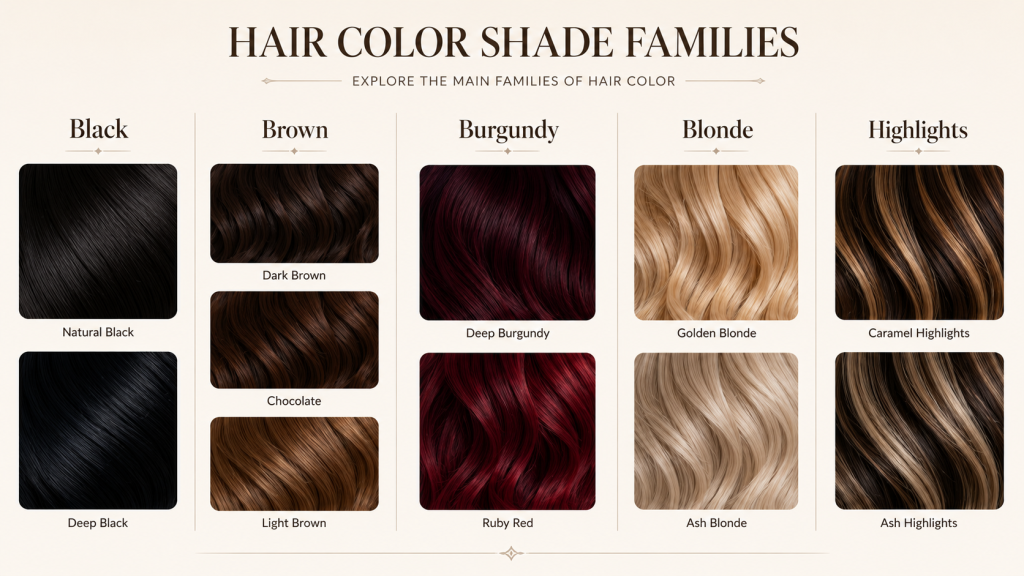
Brown
Brown is often the easiest place to start if you want a noticeable but wearable change.
Popular directions include:
- dark brown
- medium brown
- light brown
- chocolate brown
- golden brown
- milk tea brown
- frosted or cooler brown
BeautyBellBD currently offers multiple brown directions, including L’Oreal Excellence 3 Dark Brown, L’Oreal Excellence 4 Brown, L’Oreal Excellence 5.35 Chocolate Brown and Kota Milk Tea Brown.
Burgundy and Red
Burgundy is ideal for someone who wants more visible color while staying within a relatively deep shade family.
Options available on BeautyBellBD include:
- Garnier Color Naturals 1 Natural Black Hair Color
- Revlon Colorsilk 32 Dark Mahogany Brown
- Schwarzkopf Live Urban Metallics U68 Ruby Glaze
BeautyBellBD currently lists the Garnier 3.16 Burgundy product as a permanent hair color in its Hair Color collection.
Blonde
Blonde is a much broader category than many people realize.
You can have:
- golden blonde
- light blonde
- ash blonde
- very light blonde
- platinum directions
- highlighted blonde
The lighter the desired result compared with your starting point, the more important the lightening process becomes.
BeautyBellBD currently lists L’Oreal Excellence Fashion 6.13 Golden Nude Brown, L’Oreal Preference 10.1, L’Oreal Preference Ultra Platinum and balayage/highlighting products.
Black and Deep Shades
Black is not simply “one shade.”
You can find:
- natural black
- darkest black
- cool black
- deep brown-black
For someone who wants a low-drama change, a deeper shade may be more realistic than attempting a large lightening transformation.
What About Highlights and Balayage?

You do not have to color your entire head.
Highlights can create a different visual effect by adding lighter sections instead of changing the base color everywhere.
BeautyBellBD currently lists L’Oreal Preference Les Balayages Highlights for Natural Light to Dark Blonde Hair, giving you a relevant product example for this type of look.
Highlights may be attractive for someone who wants:
- dimension
- visible lighter sections
- a less uniform look
- a gradual change in appearance
The result still depends heavily on the starting hair.
Do You Need Bleach to Get Blonde?
Not necessarily for every blonde goal—but significant lightening can require a lightening process.
A darker starting base cannot always become a very light blonde simply by applying a lighter-colored dye.
That is why BeautyBellBD’s L’Oréal Colorista Lightener product is a separate lightening product rather than simply another blonde dye.
The American Academy of Dermatology also advises caution when moving substantially lighter than the natural shade; it notes that lightening more than approximately three shades generally requires higher peroxide levels and can lead to greater hair damage.
The practical lesson
If your hair is very dark and your goal is:
black → platinum blonde
that is a very different project from:
dark brown → chocolate brown
Do not choose based solely on the front of the box. Check what the manufacturer says about the starting hair color.
Permanent vs Semi-Permanent Hair Color
The type of color you choose also affects your decision.
Permanent hair color
Permanent dyes are designed to create a longer-lasting color change and are commonly used when someone wants a significant or longer-term color result.
They may also be used for gray coverage depending on the product.
Semi-permanent hair color
Semi-permanent products generally provide a less permanent color change and can be useful for someone who wants to experiment without committing to the same type of long-term change.
The exact longevity and application method vary by product, so always follow the individual manufacturer’s instructions.
How to Choose Hair Color for At-Home Use
At-home coloring can be convenient, but convenience should not replace preparation.
Before buying:
1. Check your starting hair color
Do not compare the product shade only with your desired result.
2. Read the product instructions
Look specifically for:
- suitable starting shades
- processing time
- application instructions
- precautions
- allergy-test instructions
3. Consider whether your hair has been previously colored
Previously treated hair may not respond like virgin hair.
4. Choose a realistic level of change
A subtle brown-to-chocolate transition is very different from a dark-to-blonde transformation.
5. Think about maintenance
Ask yourself:
“Will I be comfortable maintaining visible roots and color changes?”
That is especially important with significantly lighter shades.
Hair Color Safety: What You Should Know
Hair color is still a cosmetic chemical product and should be handled carefully.

The FDA advises following all package directions and recommends performing a patch test before use. It also warns against leaving dye on longer than directed and recommends wearing gloves while applying hair dye. Check the Official FDA advices here.
The NHS notes that reactions to hair dye can cause symptoms such as itching, burning, rash, dryness or blisters, and that some symptoms can take up to 72 hours to appear. It also highlights PPD as a known irritant/allergen found in many permanent and some semi-permanent dyes.
Basic precautions
- Follow the product instructions.
- Perform the recommended patch test.
- Use gloves.
- Do not leave dye on longer than directed.
- Do not mix unrelated dye products unless the manufacturer specifically instructs you to.
- Stop using a product if you develop a reaction.
- Seek medical help for a serious reaction.
Never use home hair dye on your eyebrows or eyelashes. The FDA specifically warns against this because of the risk of serious eye injury.
Hair Color Maintenance
The color-selection process does not end after rinsing the dye.
Colored hair may need a more deliberate routine, particularly when the hair has also been lightened.
Use appropriate washing habits
Frequent washing can affect the appearance and longevity of many hair colors.
Pay attention to conditioning
Your existing Hair Conditioner & Mask collection can become an important supporting destination after readers finish coloring.
BeautyBellBD already has a dedicated Conditioner & Mask subcategory, making this a natural internal-link destination.
Consider a hair oil or serum
Hair oils and serums can become useful supporting products in a post-color-care routine depending on the product and the individual’s hair needs.
BeautyBellBD currently maintains a separate Hair Oil & Serum category.
Protect your hair from excessive heat and environmental stress
The American Academy of Dermatology recommends measures such as protecting colored hair from sun exposure because coloring and other chemical treatments can make hair dry, weak or brittle.
Hair Color in Bangladesh: What Should You Consider?
For BeautyBellBD readers, product availability and local climate are practical considerations.
Bangladesh has a warm, humid climate and a pronounced monsoon season, so maintaining a comfortable hair-care routine can matter even after you choose the right shade.
When shopping online, pay attention to:
- exact shade name
- shade number
- product size
- manufacturer instructions
- starting-hair recommendations
- whether the product is currently in stock
- whether you need a separate lightener
- how the color fits your maintenance routine
Rather than asking only:
“What is the best hair color?”
ask:
“Which shade is realistic for my current hair and the look I want?”
That is a much more useful question.
A Simple Hair Color Decision Framework
Use this five-step process before you buy.
| Step | Question |
| 1 | What is my natural/current hair color? |
| 2 | What is my skin undertone? |
| 3 | Do I want warm, cool or neutral-looking color? |
| 4 | How dramatic a change do I want? |
| 5 | Will I need lightening, and am I comfortable with the maintenance? |
Example
Suppose your hair is naturally very dark and you want a visible but wearable change.
Instead of immediately choosing platinum blonde, you might compare:
Dark brown → chocolate brown → burgundy → lighter brown
You can then decide how much contrast and maintenance you actually want.
Quick Hair Color Cheat Sheet
| Your preference | Shade families to explore |
| Natural-looking change | Natural black, dark brown, medium brown |
| Rich brunette | Chocolate, dark brown, frosted brown |
| Warm look | Golden brown, copper, warm chocolate |
| Cool look | Ash brown, ash blonde, cool brunette |
| Noticeable red direction | Burgundy, ruby, reddish brown |
| Lighter transformation | Blonde, ash blonde, highlights |
| Fashion-forward look | Rose gold, copper, selected metallic/fashion shades |
These are starting points, not strict rules.
How to Shop for Hair Color Without Making a Mistake
Before clicking “buy,” compare the product with your actual needs.
Shade
Do you want brown, black, blonde, burgundy, copper or another family?
Starting hair
Is your hair natural, previously colored or already lightened?
Level of change
Are you going darker, staying around the same depth or trying to go substantially lighter?
Maintenance
Would you be comfortable maintaining roots and refreshing the color?
Application
Is the product intended for the type of home application you are planning?
Safety
Have you read the instructions and followed the recommended testing procedure?
This approach is more reliable than choosing entirely from a model’s photograph on the box.
Final Takeaway
The best hair color is not simply the shade that looks attractive in a product photo.
It is the shade that makes sense for your current hair, skin tone, undertone, desired result and maintenance preferences.
Start with your natural or current hair color. Identify your undertone. Decide whether you want a warm, cool or neutral direction. Then consider how much lighter, darker or more colorful you want to go.
Most importantly, set realistic expectations. The same box color can look different depending on the starting hair, and dramatic lightening may require additional steps.
Once you know what type of shade you are looking for, you can compare actual products much more intelligently.
Explore the Hair Color collection at BeautyBellBD to compare available shades and products in Bangladesh.
Product Recommendations
These should appear after the major educational sections, not near the top of the article.
The selection below intentionally represents different shade families rather than trying to promote every product in the inventory.
| Product | May Suit | Purpose | Why Relevant |
| L’Oreal Excellence Creme 3 Dark Brown | Readers wanting a deep brunette direction | Dark-brown example | Helps illustrate a relatively subtle move from very dark hair toward brown |
| L’Oreal Feria 50 Medium Brown | Readers exploring medium brown | Medium-brown example | Useful for demonstrating the brown shade family |
| Kota Milk Tea Brown Hair Color | Readers interested in softer brown tones | Warm/modern brown example | Gives the article a lighter brown shade example |
| Garnier Color Naturals 3.16 Burgundy | Readers wanting a visible deep red/burgundy direction | Burgundy example | Demonstrates how a deeper red family differs from standard brown |
| Revlon ColorSilk 34 Deep Burgundy | Burgundy shoppers comparing brands | Burgundy alternative | Provides a second burgundy option without creating a separate competing article |
| L’Oreal Hair Color Preference 7.1 Ash Blonde | Readers seeking a cooler blonde direction | Ash-blonde example | Excellent contextual example for cool-toned blonde selection |
| L’Oreal Preference 9.213 Rose Gold | Readers exploring lighter/fashion shades | Rose-gold example | Demonstrates how shade selection extends beyond traditional blonde/brown |
| L’Oreal Preference 7.4 | Readers interested in warmer tones | Warm color example | Useful as a contrasting warm-toned option beside ash shades |
| L’Oreal Colorista Hair Bleach & Lightener At Home Kit | Readers considering substantial lightening | Lightening example | Helps explain the difference between color selection and pre-lightening |
| L’Oreal Preference Les Balayages | Readers wanting highlights | Highlighting option | Supports the section on partial rather than all-over color |
The current BeautyBellBD product pages confirm the availability and positioning of several of these shade examples; for example, the 7.1 product is described as a cool-toned ash blonde and the current Hair Color category contains a broad range of shade options.
What is the best way to choose a hair color?
Start with your current hair color, then consider your skin tone, undertone, desired shade family and how dramatic a change you want. Finally, check whether the product is suitable for your starting hair color and whether lightening is required.
Which hair color suits a warm undertone?
Warm undertones can work well with warm-looking shades such as golden brown, caramel, warm chocolate and copper. However, personal preference matters, and cooler shades can also be chosen intentionally for contrast.
Which hair color suits a cool undertone?
Cool undertones can pair well with ash brown, ash blonde, cool brunette and some violet- or burgundy-oriented shades.
What hair color suits a neutral undertone?
Neutral undertones usually offer considerable flexibility. You can experiment with both warm and cool shades depending on your preferred look and natural hair color.
Can I apply blonde hair dye directly to black hair?
Not every blonde shade will produce the result shown on the package when applied directly to very dark hair. Significant lightening may require a separate lightening process. Always follow the specific manufacturer’s starting-color guidance.
Do I need bleach to dye my hair blonde?
It depends on the starting color and the target shade. The greater the amount of lightening required, the more likely a lightening process will be involved.
What do hair color numbers mean?
Hair-color numbers generally communicate depth and tone information, but numbering systems differ between brands. Always use the manufacturer’s specific shade chart rather than assuming identical numbering across brands.
Is brown hair color a good option for beginners?
Brown can be a practical starting family when you want a noticeable change without immediately pursuing an extreme lightening transformation. The appropriate shade still depends on your starting hair.
Is burgundy hair color suitable for dark hair?
Burgundy is a popular deep-color direction and may create a visible change on dark hair, although the exact result varies by starting color and product.
How often should I color my hair?
There is no universal schedule. It depends on the product, how quickly roots become visible, how fast your hair grows and how much color fading you experience.
Should I patch-test hair dye?
Yes. The FDA recommends following the product’s patch-test instructions before use.
What should I do if hair dye causes burning or a rash?
Stop using the product and follow the relevant medical guidance. Hair-dye reactions can include itching, burning, rash and swelling. The NHS notes that serious reactions are rare but require urgent attention when severe symptoms such as breathing difficulty or swelling of the mouth/throat occur.
Can I mix different hair dye products?
Do not mix products unless the manufacturer specifically instructs you to do so. The FDA explicitly advises consumers not to mix different hair dye products.
Should I choose hair color based only on skin tone?
No. Skin tone and undertone are useful factors, but your current hair color, previous treatments, desired result and maintenance expectations are equally important.


 English
 Bengali