
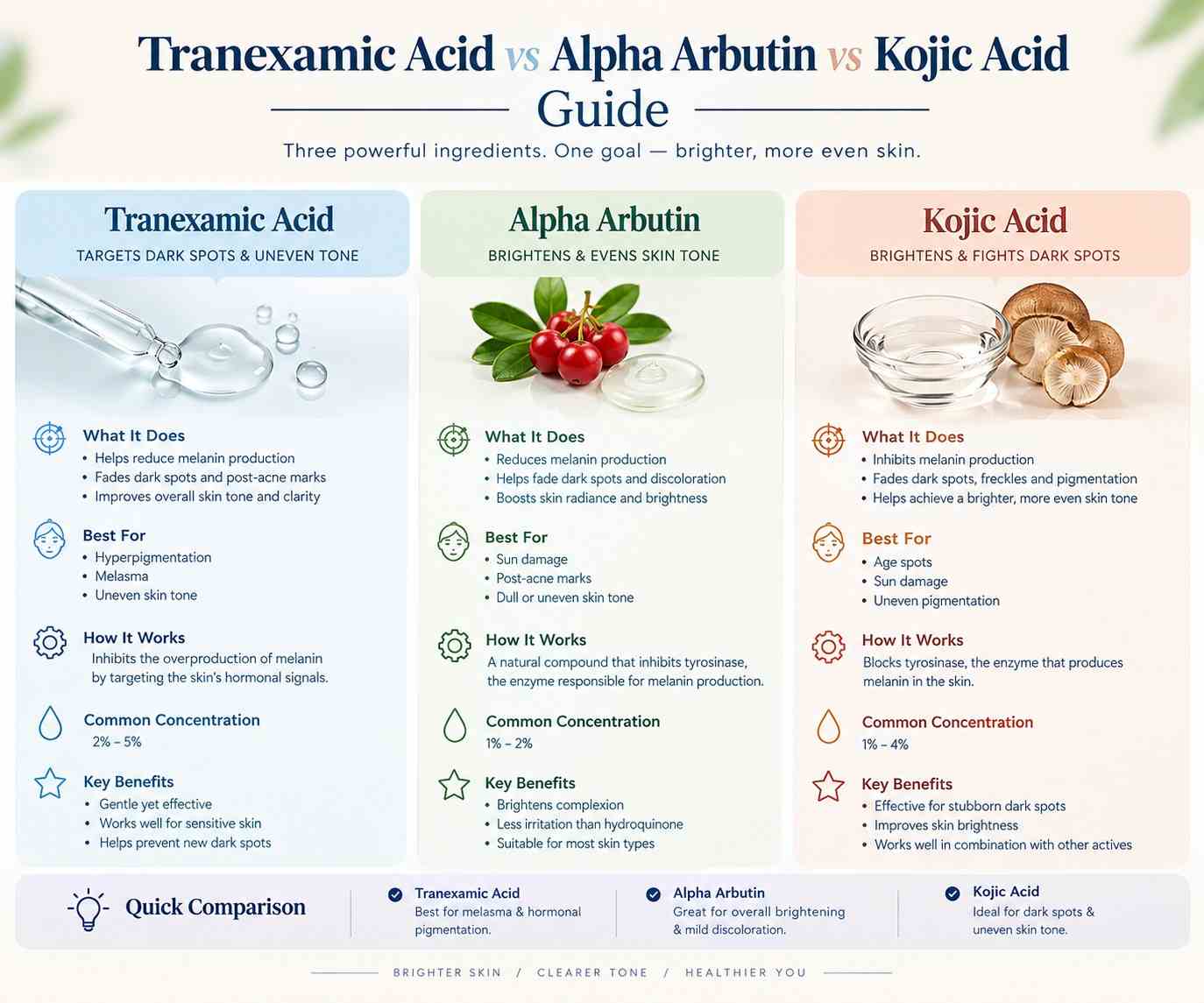
Tranexamic Acid vs Alpha Arbutin vs Kojic Acid Guide
Compare tranexamic acid vs alpha arbutin vs kojic acid for pigmentation, dark spots, melasma, and acne marks. Learn which ingredient suits your skin.
What Is Tranexamic Acid?
TXA, or Tranexamic acid, is an ingredient that has gained recognition in skincare because of its effectiveness in treating pigmentation and, more specifically, melasma. Unlike other brightening ingredients that focus on inhibiting tyrosinase, studies of tranexamic acid have shown that this ingredient affects the UV-induced pathways of pigmentation and inflammation. Studies of tranexamic acid have focused on topical, oral, and intradermal administration for melasma.
How Does Tranexamic Acid Work for Pigmentation?
Exposure to UV light can promote the mechanisms that stimulate melanin production. Tranexamic acid. Tranexamic acid may inhibit the plasmin-dependent pathway of such processes. Therefore, the use of TXA will be especially appealing for those people whose primary issue is:
- Melasma
- Pigmentation
- Post-inflammatory hyperpigmentation
- Dark spots
- Sun-induced discoloration
According to a literature review of 2026, there is some scientific support for the use of tranexamic acid as a potential solution to melasma and post-inflammatory hyperpigmentation, taking into account the route of treatment.
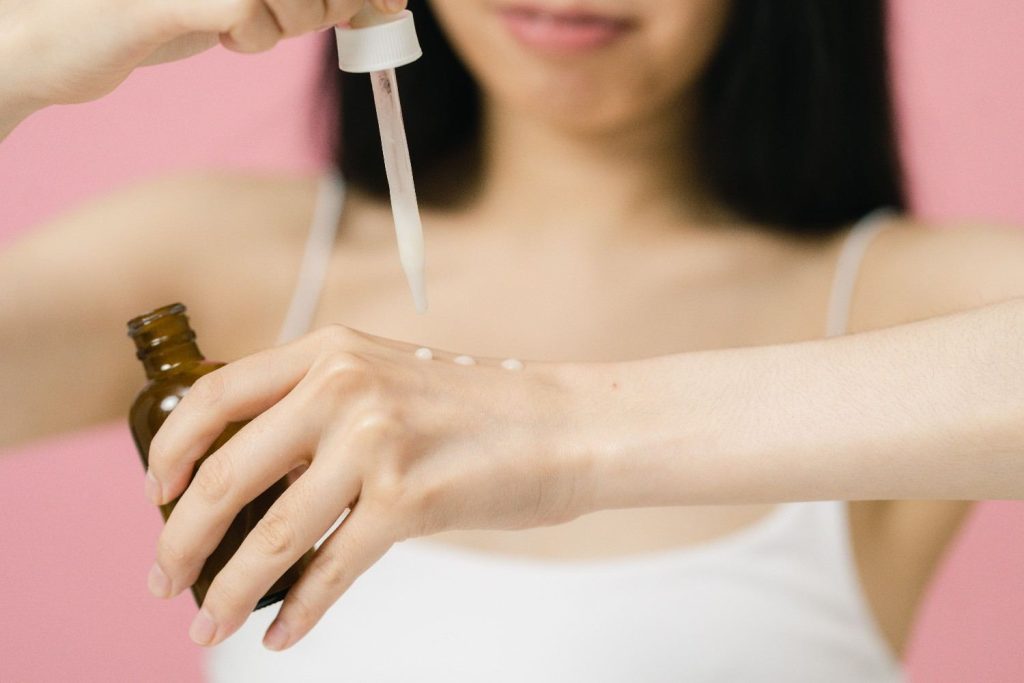
Is Tranexamic Acid Gentle?
Topical tranexamic acid has been seen to be rather well-tolerated. In accordance with a systematic review and meta-analysis, the level of irritation caused by topical tranexamic acid is less compared to other pigmentation agents.
Oral TXA, on the other hand, is distinct from topical serum, in the sense that one should not initiate taking TXA orally for the purpose of cosmetic pigmentation since it has contraindications.
What Is Alpha Arbutin?
Alpha-arbutin is among the ingredients for skin lightening and is derived from arbutin and added to skin-toning serums dealing with uneven skin tone and dark spots. The process through which alpha-arbutin works is by inhibiting tyrosinase. The tyrosinase enzyme is responsible for producing melanin, and when inhibited can reduce the formation of melanin.
Potential Benefits of Alpha Arbutin
Alpha-arbutin might be beneficial for improving:
- Post-acne scarring
- Dark skin pigments due to sun exposure
- Uneven skin tones
- Hyperpigmentation
- Dull skin tone
There is less evidence available for arbutin in melasma than there is for some other proven treatments. According to a systematic review, further high-quality comparative studies are required to prove the efficacy of arbutin in melasma.
The difference is important: an ingredient can be popular without necessarily having the same amount of clinical evidence for all pigmentation problems.
How Strong Is the Evidence for Alpha Arbutin?
Alpha arbutin has a clear mode of action and is commonly used in cosmetic products. Nonetheless, scientific evidence on the use of arbutin in melasma is limited compared to other conventional therapies.
Evidence-based research revealed that the effectiveness of arbutin in melasma treatment was hard to prove due to the absence of comparative studies. This doesn’t mean that alpha arbutin doesn’t work. It simply means that one shouldn’t expect too much, especially in cases of melasma resistant to treatment.
What Is Kojic Acid?
The use of kojic acid is another common practice in treating problems associated with pigmentation. Its main function lies in the inhibition of the tyrosinase enzyme. The said enzyme plays an important role in the formation of melanin, so by inhibiting this enzyme, the biochemical process of pigmentation can be hindered.
Kojic acid has been considered a potential topical treatment for melasma and other cases of hyperpigmentation. This claim has been supported by findings from a systematic review and meta-analysis.
Potential Benefits of Kojic Acid
Kojic acid can be an ingredient used in treatments that aim to tackle:
- Dark spots
- Irregular pigmentation
- Post-inflammatory hyperpigmentation
- Pigmentation from sun exposure
- Melasma within an overall skincare routine
Clinical studies support the use of kojic acid as one of the non-hydroquinone agents used to treat melasma, but the quality of studies varies.
How it works: Unlike alpha arbutin, kojic acid reduces the activity of tyrosinase, but by means of a different mechanism and more effectively. Kojic acid has some antibacterial and antioxidative properties; that is why it is sometimes used as a part of skin care products intended for treating acne.
Best for:
- Persistent hyperpigmentation unresponsive to more gentle actives
- Tone imbalance resulting in dull complexion
- Acne-prone skin (thanks to its antibacterial activity) in combination with
Typical strength in skincare: 1–4%.
Side effects: More prone to irritation and redness, and also possibly causing contact dermatitis, compared to the other two. Additionally, kojic acid may be less stable in formulations, meaning that it is decomposed more quickly in contact with oxygen and light.
Tranexamic Acid vs Alpha Arbutin vs Kojic Acid: Key Differences
| Feature | Tranexamic Acid | Alpha Arbutin | Kojic Acid |
| Main skincare purpose | Pigmentation and melasma support | Dark spots and uneven tone | Dark spots and pigmentation |
| Primary action | Influences pigmentation-related inflammatory pathways | Tyrosinase inhibition | Tyrosinase inhibition |
| Often considered for | Melasma, persistent pigmentation | Mild-to-moderate uneven pigmentation | Dark spots and hyperpigmentation |
| Skin tolerance | Often well tolerated topically | Generally considered a gentler brightening option | May irritate some users |
| Evidence for melasma | Promising | More limited | Supported, but evidence varies |
| Best role | Targeted pigmentation support | Daily brightening routine | Targeted pigmentation treatment |
Tranexamic Acid vs Alpha Arbutin: Which Should You Pick?
Pick tranexamic acid if your hyperpigmentation is hormone- or inflammation-induced, such as in melasma, post-pregnancy pigmentation, and spots after acne breakouts. This product targets the underlying trigger rather than hyperpigmentation itself.
Select alpha arbutin if you are primarily concerned about dull skin and sun-related discoloration that isn’t too severe, and you would like an ingredient that is gentle enough for constant use.
Today, there are many dermatology serums that include both of them, because each of them addresses the issue of hyperpigmentation differently.
Alpha Arbutin vs Kojic Acid: Which Is Stronger?
Both of these ingredients function by inhibiting the same enzyme, although kojic acid does so more aggressively. This leads to a possibility of more rapid fading of difficult spots, but at the price of increased likelihood of irritation. Skin dryness, redness, or stinginess is a much more likely side effect of kojic acid use, particularly in humid or hot regions where sweating increases the chances of irritation.
If your skin has a tendency to react to products, then begin by using alpha arbutin. If you have been using arbutin for many months with very little effect on your deeper and older dark spots, then the obvious choice is to use kojic acid.
Tranexamic Acid vs Kojic Acid: Which Fades Melasma Faster?
Tranexamic acid will prove to be more efficacious in the treatment of melasma compared to kojic acid because the former works by blocking the factors (hormonal and vascular) that cause melasma to recur. Kojic acid would work on the reduction of the already present pigmentation, but it cannot treat the causes of melasma recurrence. This is why melasma usually relapses when kojic acid alone is used.
Tranexamic Acid vs Alpha Arbutin vs Kojic Acid: How to Choose
Follow this straightforward checklist:
Choose Tranexamic Acid If:
- The problem you wish to tackle is pigmentation.
- You have skin that gets melasma easily.
- The ingredient you are seeking is a clinically proven pigment-fighting one.
- You like using serums for your skin care routine.
Choose Alpha Arbutin If:
- This is the first time you are trying brighteners.
- You are looking for a less harsh brightener.
- You want to deal with dark spots and uneven complexion.
- You need an ingredient that will fit nicely into your routine.
Choose Kojic Acid If:
- The problem you have is dark spots on your skin.
- You are in need of an ingredient that inhibits tyrosinase activity.
- Your skin responds well to skin-lightening ingredients.
- You favor skin-brightening treatments.
Can You Use All Three Together?
Yes, and many of today’s triple-action brightening serums are designed precisely in this manner, frequently combined with niacinamide, vitamin C, or licorice extract. Since each compound operates on a different mechanism, their combination may produce better results than the use of either one of them individually.
An easy system to combine them in layers:
- Cleanser
- Then, the tranexamic acid serum (this quiets the trigger)
- Next, the alpha arbutin/kojic acid (prevents new pigment from forming)
- Moisturizer to help the skin barrier function
- And daily sun protection — none of the above will work if UV radiation continues to trigger pigmentation.
For first-time active users, don’t add all of the three right away. Start with one, then add another in 1-2 weeks.
Best BeautyBellBD Products to Mention
1. AXIS-Y Dark Spot Correcting Glow Serum 50ml
AXIS-Y Dark Spot Correcting Glow Serum can be considered in relation to skincare for pigmentation. BeautyBellBD describes the ingredients of this serum, such as 5% niacinamide and squalane, which make the product relevant to pigmentation skincare.
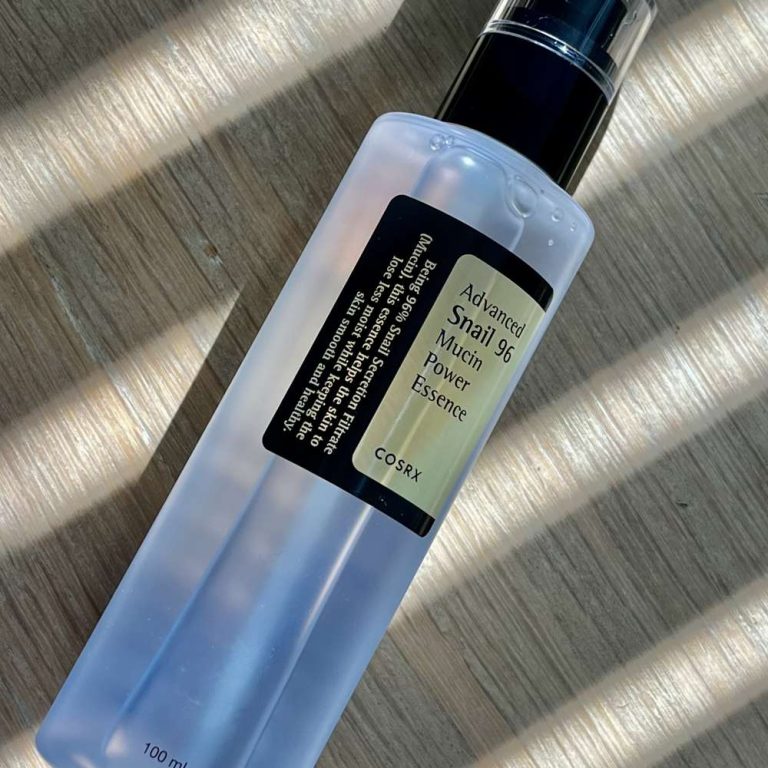
2. COSRX Advanced Snail 96 Mucin Power Essence
COSRX Advanced Snail 96 Mucin Power Essence provides good hydration for the skin and can be considered a supportive product to apply together with products for skin pigmentation.
3. Beauty of Joseon Sunscreen
The Beauty of Joseon Sunscreen is highly pertinent to pigmentation care since regular application of sunscreen ensures that dark spots do not become more visible. It would help with maintaining a brightening skincare regimen consistently.
4. La Roche-Posay Anthelios Melt-In Milk Sunscreen SPF 60
This sunscreen shields the skin from the damaging effects of the harmful rays of the sun. This La Roche-Posay Anthelios Melt-In Milk Sunscreen SPF 60 is capable of providing protection from UVA and UVB rays that damage the skin.
5. Hada Labo Gokujyun All in One Perfect Gel
The Hada Labo Gokujyun All in One Perfect Gel serves to provide moisture in a single product. According to BeautyBellBD, this is an all-in-one moisturiser, serum, and essence that will help to give the user comfortable and hydrated skin.
Why Is Sunscreen Important When Treating Dark Spots?
Daily sun protection is crucial for any pigmentation regimen as well. Sunlight can increase pigmentation and also cause dark spots to become persistent. Although the skin-lightening ingredient that is incorporated in the skincare routine is effective, it will not have any effect owing to constant exposure to sunlight.
Individuals suffering from melasma and hyperpigmentation need to apply broad-spectrum sunscreen on a regular basis. This becomes even more important in Bangladesh owing to excessive sunlight exposure in Bangladesh that makes pigmentation even more difficult. In the case of the Bangladeshi skincare routine, it will include:
- SPF of 30 or higher (broad-spectrum)
- Adequate usage
- Usage while staying outdoors for long periods of time
- Use hats and shades where feasible
- Prevention of midday sun exposure
Which Is Better for Melasma?
Of these three, tranexamic acid is particularly significant in the treatment of melasma. There have been various studies done on its application, which include topical, oral, and intradermal applications. In a systematic review on topical treatment of melasma, tranexamic acid has emerged as one of the treatments, other than hydroquinone, that shows remarkable efficacy. However, melasma is a chronic disorder that can recur, and the treatment involves more than one stage. The effective way to do this involves:
- Broad-spectrum sunscreen daily.
- A good pigment active.
- Gentle cleansing.
- Barrier-supporting moisturizer.
- Good skincare practices.
- Professional consultation if there is persistent or increasing pigmentation.
Photoprotection is essential since it prevents further increase in pigmentation due to UV exposure.
Which Is Better for Acne Marks?
There are various kinds of spots with their own significance. Brown spots are those related to hyperpigmentation, while red spots are a totally different issue. For brown acne spots, some useful ingredients that can help include alpha arbutin, tranexamic acid, and kojic acid. The reason for treating your spots when having recurring acne is that otherwise, new spots will keep coming.
FAQs
Can kojic acid fade melasma?
Kojic acid can assist in reducing the production of melanin and managing melasma. Nonetheless, melasma is known to recur, hence the need for continued use of sunscreen and treatment.
How long do these ingredients take to work?
Pigmentation improvement takes time. The use of these products for weeks or months may be needed before there is visible change, depending on the underlying causes, among other things.
Can I use all three ingredients together?
All three products can be used at once, although the combination of different actives increases the risk of irritation. Introducing new products should be done gradually and not together at once.
Should I use sunscreen with these ingredients?
Yes, the use of sunscreen is necessary when treating pigmentation. Ultraviolet radiation is capable of worsening the condition, hence reducing the effectiveness of the treatment.
Conclusion
Tranexamic acid, alpha arbutin, and kojic acid help in pigmentation care in their own way. Tranexamic acid is good for melasma, alpha arbutin helps in brightening your skin every day gently, while kojic acid helps to lighten stubborn dark spots. Sun protection, moisturisation, and gradual use of actives can improve results and lower irritation and recurrence of pigmentation.

 English
 Bengali