
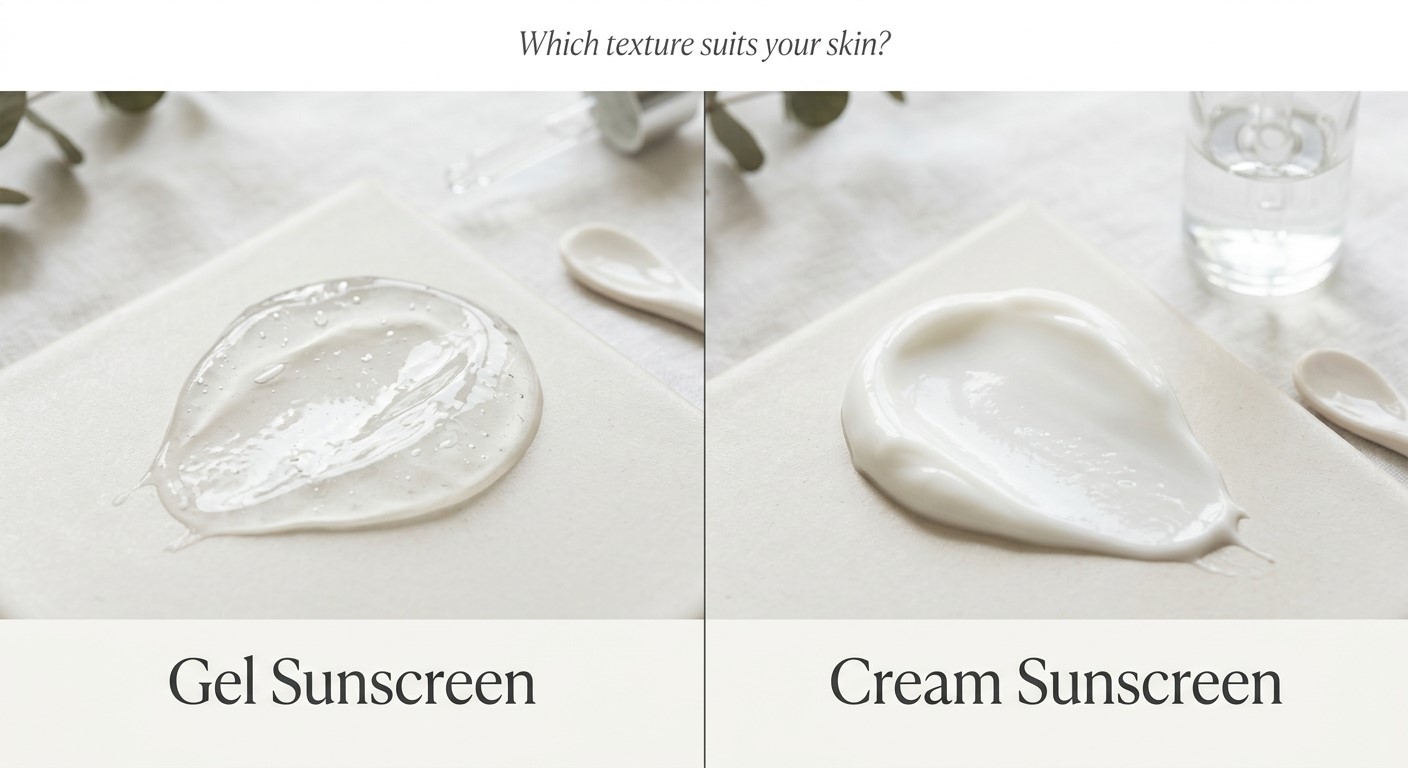
Gel vs Cream Sunscreen: Which Is Better for Oily, Dry & Acne-Prone Skin?
For many people with oily, combination or acne-prone skin, a gel sunscreen feels easier to wear because the texture is usually lighter. If your skin is dry, dehydrated or frequently feels tight, a cream sunscreen may feel more comfortable because cream formulations often offer a richer, more moisturizing skin feel.
However, neither gel nor cream is inherently more effective against UV radiation.
A sunscreen’s protection depends on its tested SPF and UVA protection, along with how generously and consistently it is applied. The American Academy of Dermatology recommends broad-spectrum SPF 30 or higher and water resistance when appropriate. (American Academy of Dermatology)
What Is a Gel Sunscreen?
A gel sunscreen uses a lightweight gel or gel-like vehicle to deliver UV filters across the skin.
The exact composition varies significantly between products. Some gels feel watery, some feel silicone-smooth, and others resemble lightweight gel creams.
People often prefer gel sunscreens because they can:
- feel lightweight on oily skin
- spread easily
- leave less noticeable heaviness
- work comfortably during humid weather
- sit well underneath makeup
- feel easier to reapply during the day
The AAD specifically lists gels as a useful sunscreen format for oily complexions and hairy areas. (American Academy of Dermatology)
However, the word “gel” does not automatically mean oil-free, non-comedogenic, fragrance-free or suitable for sensitive skin. Always evaluate the individual formula.
What Is a Cream Sunscreen?
Cream sunscreen uses a richer emulsion-style vehicle.
Compared with a very lightweight gel, a cream typically contains a higher proportion of ingredients that provide emollience, moisture or a more cushioned skin feel.
Cream sunscreen can therefore be particularly comfortable when your skin:
- feels dry after cleansing
- becomes flaky
- needs more emollience
- feels uncomfortable with very lightweight formulas
- is exposed to drier indoor environments or cooler weather
The AAD notes that creams can work particularly well for dry skin and facial application. (American Academy of Dermatology)
That does not mean every cream sunscreen is greasy. Modern cream sunscreens can range from rich and dewy to surprisingly lightweight.
Does Gel Sunscreen Protect Less Than Cream Sunscreen?
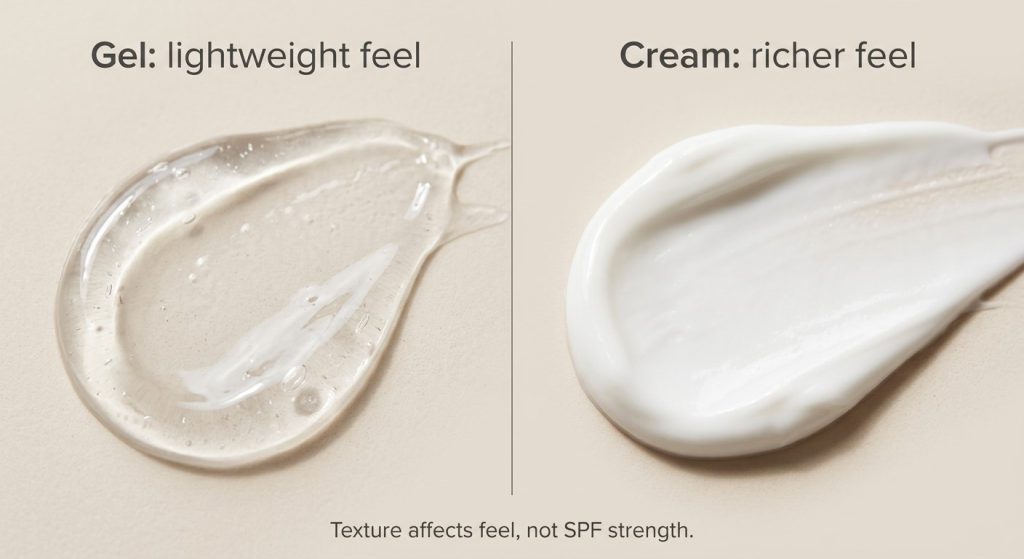
No. Texture does not determine the level of sun protection.
An SPF 50 gel does not automatically provide less protection than an SPF 50 cream simply because it feels lighter.
SPF primarily indicates protection against sunburn-producing UVB radiation, while broad-spectrum labeling indicates protection against both UVA and UVB radiation. (U.S. Food and Drug Administration)
This means you should compare:
Gel SPF 50 vs Cream SPF 50 based on tested protection, UVA coverage, water resistance, application and wearability, not on thickness.
A thick sunscreen is not necessarily stronger, and a lightweight sunscreen is not necessarily weaker.
Gel Sunscreen vs Cream Sunscreen for Oily Skin
Gel sunscreen is usually the more practical starting point for oily skin.
A lightweight formula can reduce the uncomfortable heavy feeling that sometimes occurs when moisturizer, sunscreen and makeup are layered together.
If your face becomes shiny quickly, look for descriptions such as:
- lightweight
- non-greasy
- oil-free
- matte or natural finish
- suitable for oily skin
- non-comedogenic, where supported by the product
Do not assume all gels control oil. Some are intentionally hydrating or dewy.
The goal is not necessarily to make your skin completely matte. The priority is finding a sunscreen that you will apply generously and consistently.
Prefer a lighter sunscreen? Explore gel sunscreen options such as Deconstruct Gel Sunscreen and Fixderma Shadow Gel Sunscreen.
Gel vs Cream Sunscreen for Acne-Prone Skin
Many people with acne-prone skin prefer gel sunscreen because lighter textures can feel more comfortable.
However, gel does not automatically mean acne-safe, and cream does not automatically mean pore-clogging.
Breakouts depend on the complete formulation and individual skin response.
For acne-prone skin, consider:
- overall formula
- skin feel
- whether the product is described as non-comedogenic
- fragrance sensitivity
- how it behaves with acne treatments
- whether you can apply the required amount without discomfort
If your acne treatment has made your skin unusually dry or irritated, a comfortable cream or moisturizing sunscreen may sometimes work better than an aggressively mattifying gel.
Cream Sunscreen for Dry or Dehydrated Skin
Dry skin often benefits from the richer feel of a cream sunscreen.
A moisturizing sunscreen can make the morning routine simpler because it may reduce the need for several heavy layers underneath.
Ingredients commonly used for hydration or emollience in sunscreen formulas can include substances such as:
- glycerin
- hyaluronic acid
- panthenol
- ceramides
- squalane
- various emollients
But ingredient lists vary considerably between products. Always check the current packaging for the final formulation.
If your cream sunscreen already gives enough comfort, you may not need a heavy moisturizer underneath.
What About Combination Skin?
Combination skin can use either format.
If your T-zone becomes oily while your cheeks remain comfortable or slightly dry, consider:
- a lightweight gel-cream
- watery sunscreen
- lightweight cream
- moisturizing gel sunscreen
Season can also affect your preference.
You might enjoy a gel during humid summer weather but prefer a slightly richer sunscreen when your skin becomes drier.
There is no requirement to use the same sunscreen texture throughout the entire year.
Which Is Better for Sensitive Skin?
Sensitive skin should not choose sunscreen by gel vs cream alone.
Check the full formulation.
Some gel formulas contain ingredients that certain people find irritating, while some creams contain fragrance or other ingredients that may not suit reactive skin.
If your skin frequently develops burning, persistent redness or irritation, consider looking for a simpler formulation and discussing persistent sensitivity with a dermatologist.
The AAD also notes that mineral sunscreens containing zinc oxide and/or titanium dioxide can be useful options for people with sensitive skin. (American Academy of Dermatology)
Gel vs Cream Sunscreen for Bangladesh Weather
In warm and humid conditions, skin feel becomes especially important.
If heavy sunscreen makes you sweat excessively, feel sticky or avoid reapplication, a lighter gel, fluid or watery sunscreen may be easier to maintain throughout the day.
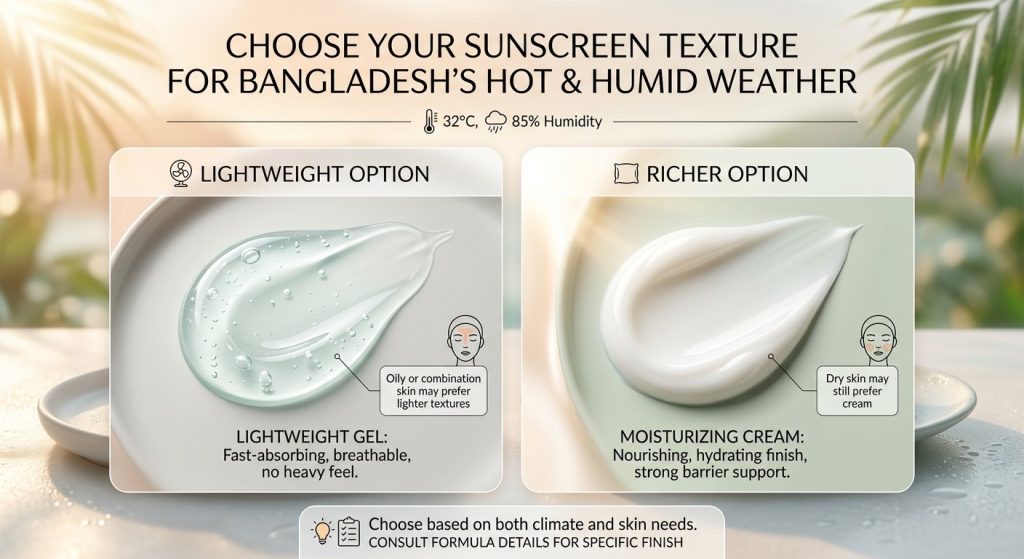
For this reason, oily and combination skin users in Bangladesh may often prefer gel textures.
But climate should not override your skin condition.
Someone with naturally dry skin may still feel more comfortable wearing a lightweight cream sunscreen even during warm weather.
Think of climate as one deciding factor, not the only factor.
Gel or Cream Sunscreen Under Makeup?
Both can work under makeup.
Gel sunscreen often has an advantage when someone wants minimal layering because a lightweight texture may settle more quickly.
Cream sunscreen can also create a smooth base, especially when dry skin would otherwise make foundation look patchy.
Pilling depends on the complete routine, not only the sunscreen texture.
To reduce pilling:
- Avoid unnecessarily layering several heavy products.
- Allow skincare layers to settle.
- Apply sunscreen evenly rather than repeatedly rubbing it.
- Let sunscreen set before applying foundation.
- Avoid mixing sunscreen directly into your moisturizer or foundation.
Apply skincare and sunscreen as separate layers so you can use an adequate amount of sunscreen.
Does Gel Sunscreen Leave Less White Cast?
Not necessarily.
White cast depends more on the UV filter system, pigments, formulation and your skin tone than on whether the product is called a gel or cream.
Some gel sunscreens appear virtually transparent.
Other gel, cream or mineral formulas can leave noticeable residue.
Always judge the individual sunscreen rather than assuming all gels are invisible.
What Matters More Than Gel vs Cream?
Texture matters because comfort influences whether you actually wear your sunscreen.
But several factors are more important for protection.
1. SPF
Look for adequate SPF protection. The American Academy of Dermatology recommends SPF 30 or higher. (American Academy of Dermatology)
2. UVA Protection
Look for broad-spectrum UVA/UVB protection. Asian sunscreens frequently display a PA rating as additional UVA-protection information.
3. Water Resistance
If you expect significant sweating, outdoor activity or swimming, check whether the sunscreen is specifically labeled water resistant.
No sunscreen should be assumed to be waterproof. (U.S. Food and Drug Administration)
4. Skin Compatibility
The formula should feel comfortable enough that you can apply the proper amount.
5. Finish
Consider whether you prefer:
- matte
- natural
- satin
- dewy
6. Routine Compatibility
A good sunscreen should work reasonably well with your moisturizer, makeup and other daytime skincare.
How to Use Gel or Cream Sunscreen Correctly
The application principles are essentially the same for both textures.
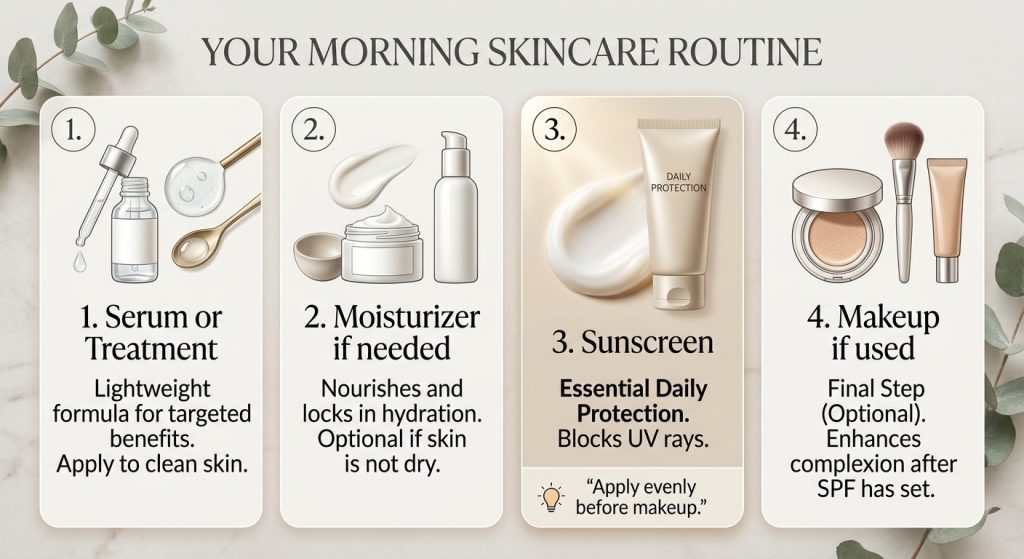
Use sunscreen as the final major step of your morning skincare routine before makeup.
Apply it evenly to exposed areas, including commonly forgotten areas such as the ears and neck.
The AAD recommends applying sunscreen before going outdoors and reapplying approximately every two hours when outdoors, as well as after swimming or sweating according to the product’s water-resistance directions. (American Academy of Dermatology)
Do not deliberately use less sunscreen simply because a cream feels heavy. If you cannot comfortably apply enough of a particular product, consider switching to a more wearable texture.
Can You Apply Moisturizer Before Gel Sunscreen?
Yes.
If your skin needs additional hydration, apply moisturizer first and sunscreen afterward.
But not everyone requires a separate moisturizer underneath sunscreen.
For example:
Oily skin: moisturizer may be unnecessary if the sunscreen already feels sufficiently hydrating.
Dry skin: moisturizer underneath sunscreen may improve comfort.
Combination skin: use whichever combination avoids both tightness and excessive heaviness.
Your sunscreen should remain the final skincare layer before makeup.
Can Gel or Cream Sunscreen Be Used With Vitamin C, Niacinamide or Other Serums?
Generally, yes.
Common daytime ingredients such as niacinamide or vitamin C can normally be used earlier in the routine, followed by moisturizer if required and then sunscreen.
You do not need to avoid sunscreen because you use active skincare.
In fact, reliable sun protection becomes particularly important when your routine focuses on concerns such as visible dark spots, uneven tone or photoaging.
If multiple actives are making your skin irritated, simplify the routine rather than trying to compensate with additional layers.
Common Mistakes When Choosing Between Gel and Cream Sunscreen
Choosing only by skin type
Oily skin does not automatically hate every cream, and dry skin does not automatically hate every gel.
Evaluate the actual formula.
Assuming SPF 50 gel is weaker
SPF protection is based on standardized testing, not product thickness. (U.S. Food and Drug Administration)
Using too little because the sunscreen feels heavy
If applying the correct amount feels unpleasant, switch textures rather than intentionally underapplying.
Ignoring UVA protection
Do not focus only on the SPF number. Broad-spectrum UVA protection is also important. (U.S. Food and Drug Administration)
Assuming sunscreen replaces every other sun-protection measure
Sunscreen is one part of sun protection. Shade, protective clothing, hats and sunglasses also help reduce UV exposure. (American Academy of Dermatology)
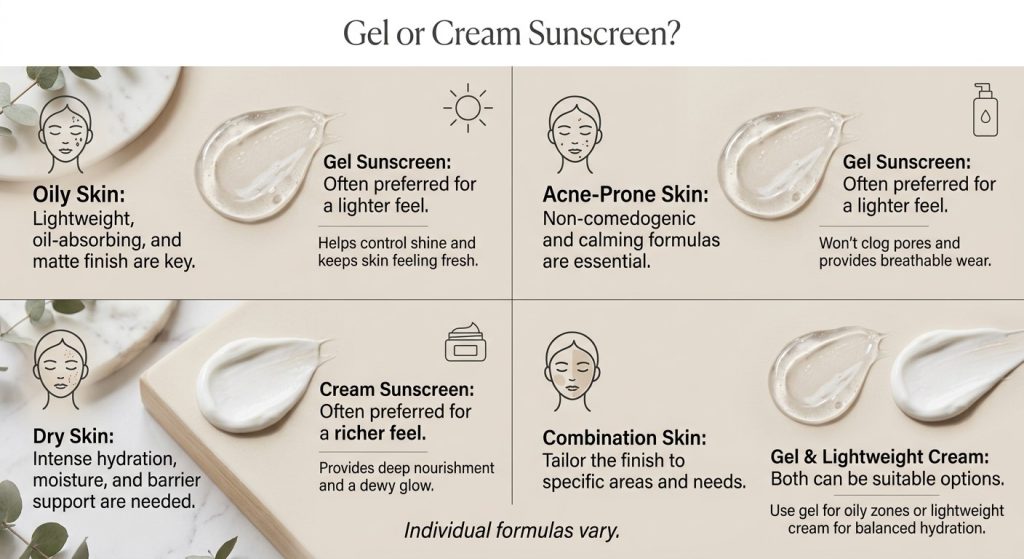
Comparison between Gel vs Cream Sunscreen
| Feature | Gel Sunscreen | Cream Sunscreen |
| Typical texture | Lightweight, gel-like or watery | Creamy, richer emulsion |
| Skin feel | Often lighter | Usually more emollient |
| Oily skin | Often a good starting choice | May work if lightweight |
| Acne-prone skin | Frequently preferred for comfort | Can still work depending on formula |
| Dry skin | May require moisturizer underneath | Often comfortable |
| Combination skin | Usually suitable | Lightweight creams may also work |
| Sensitive skin | Depends on complete formula | Depends on complete formula |
| Humid weather | Often more comfortable | May feel richer |
| Under makeup | Often layers easily | Can work well, especially on dry skin |
| Finish | Often natural, fresh or matte | Often natural, satin or dewy |
| Hydration | Formula-dependent, often lighter | Usually higher emollience |
| White cast | Depends on UV filters/formulation | Depends on UV filters/formulation |
| UV protection | Determined by tested SPF/UVA protection | Determined by tested SPF/UVA protection |
| Best choice | When lightweight wearability is priority | When additional comfort/moisture is priority |
Key point: these are general texture tendencies, not rules. Individual formulations matter more than the words “gel” or “cream.”
Still deciding? Compare sunscreen textures based on your skin type before choosing. Explore gel, cream, watery and lightweight sunscreens available at BeautyBellBD.
View BeautyBellBD Sunscreen Collection
Product Recommendations
Deconstruct Gel Sunscreen for Oily Skin SPF 50 PA++++ 50g
May suit: Oily and combination skin that dislikes heavy sunscreen.
Purpose: High daily UV protection in an airy gel texture.
Why relevant: It provides a clear example of the gel side of this comparison. BeautyBellBD describes it as lightweight, airy and non-greasy and positions it specifically for oily skin. (Beauty Bell BD)
View Deconstruct Gel Sunscreen at BeautyBellBD
Fixderma Shadow Pore Minimizing Gel Sunscreen SPF 50 PA+++
May suit: Customers who prefer gel sunscreen and a non-greasy daily feel, particularly during warm weather.
Purpose: Daily SPF 50 PA+++ protection in a gel format.
Why relevant: This is another direct gel-format example available on BeautyBellBD and can support comparison-oriented product discovery without making the article brand-focused. (Beauty Bell BD)
View Fixderma Shadow Pore Minimizing Gel Sunscreen
Biore UV Aqua Rich Watery Gel Sunscreen
May suit: Customers who prefer an especially watery, lightweight sunscreen feel.
Purpose: SPF 50+ PA++++ protection in a watery gel format.
Why relevant: It shows that not every gel sunscreen feels the same. BeautyBellBD’s current page describes a lightweight watery formula and lists hydrating ingredients including sodium hyaluronate. Customers with ingredient sensitivities should check the complete current formula before purchasing. (Beauty Bell BD)
View Biore UV Aqua Rich Watery Gel Sunscreen
Fixderma Shadow Sunscreen Cream SPF50+ PA+++
May suit: Customers who prefer a traditional cream sunscreen texture rather than a gel.
Purpose: Daily high-SPF protection in cream format.
Why relevant: It creates a direct same-brand comparison opportunity between Fixderma gel and cream sunscreen textures. (Beauty Bell BD)
View Fixderma Shadow Sunscreen Cream
3W Clinic Intensive UV Sunblock Cream SPF50+ PA+++
May suit: Customers who want a cream-format sunscreen but prefer a relatively lightweight skin feel.
Purpose: Everyday SPF50+ PA+++ protection in cream format.
Why relevant: BeautyBellBD currently describes it as a lightweight, non-greasy cream sunscreen, demonstrating that “cream” does not automatically mean extremely rich or greasy. (Beauty Bell BD)
View 3W Clinic Intensive UV Sunblock Cream
Which Is Better: Gel or Cream Sunscreen?
Neither texture is universally better. Gel sunscreen generally makes sense when you want a lightweight, less heavy feel, especially for oily, combination or acne-prone skin. Cream sunscreen can be more comfortable when your skin is dry, dehydrated or prefers a richer texture.
The most important point is that texture does not determine UV protection. Choose adequate SPF and UVA/broad-spectrum protection, use enough product, reapply when necessary and select a formula comfortable enough to wear consistently. (American Academy of Dermatology)
For Bangladesh customers who are ready to compare actual options, direct them naturally to the BeautyBellBD sunscreen collection, where gel, cream, watery and other sunscreen formats can be compared by skin type and preferred finish.
Is gel sunscreen better than cream sunscreen?
Neither is universally better. Gel sunscreen is often preferred by oily or combination skin because of its lighter feel, while cream sunscreen may be more comfortable for dry skin. The best choice depends on your skin type, climate, preferred finish, and whether the formula provides suitable broad-spectrum protection.
Is cream sunscreen better for dry skin?
Cream sunscreen can be a good choice for dry skin because it often has a more moisturizing texture. However, the label alone doesn’t determine how hydrating a product will be. Check the actual formulation and choose a sunscreen that leaves your skin comfortable without excessive dryness or irritation.
Is gel sunscreen good for oily skin?
Yes. Gel sunscreen is often a popular choice for oily skin because lightweight formulas can feel more comfortable and less heavy. However, individual formulations vary, so look for a product with a finish and texture that suits your skin rather than choosing solely because it says “gel.”
Can sensitive skin use cream sunscreen?
Yes, sensitive skin can use cream sunscreen, but the complete formula matters more than the texture. Check the ingredient list and consider how your skin reacts to the product. If your skin is easily irritated, patch testing a new sunscreen may be helpful before applying it broadly.
Is gel sunscreen suitable for humid weather?
Gel sunscreen can be particularly comfortable in hot and humid weather because lightweight formulas may feel less heavy on the skin. However, a cream sunscreen can also work well if you have dry skin or prefer a moisturizing finish. Comfort and consistent use are key considerations.
Can I wear cream sunscreen under makeup?
Yes. Cream sunscreen can be worn under makeup if the formula layers well with your other products. Allow your sunscreen to settle before applying makeup, and choose a formula that doesn’t excessively pill or leave a finish you dislike.
Does gel sunscreen protect as well as cream sunscreen?
A gel sunscreen can provide effective protection just like a cream sunscreen when it has an appropriate SPF and broad-spectrum protection and is applied correctly. Texture itself does not determine the sunscreen’s protection level. Always check the product’s stated protection and follow its application instructions.
Which sunscreen is better for daily use?
The best sunscreen for daily use is one that provides appropriate broad-spectrum protection and feels comfortable enough for you to apply consistently. For many oily-skin users, a lightweight gel may be preferable. For dry skin, a moisturizing cream may be more comfortable.
Should I choose SPF 30 or SPF 50?
Both SPF 30 and SPF 50 can provide substantial UVB protection when used correctly. A broad-spectrum SPF 30 or higher is generally recommended for everyday sun protection. SPF 50 may be preferable for people who want higher labeled protection, particularly during significant sun exposure.
Does sunscreen texture affect white cast?
Texture can influence how a sunscreen looks and feels on the skin, but white cast is primarily related to the specific formulation and UV-filter ingredients. Two products with the same texture can have completely different appearances, so check the individual product rather than assuming gel or cream determines white cast.
Should I choose water-resistant sunscreen?
Water-resistant sunscreen can be useful when you’ll be swimming, exercising, sweating heavily, or spending extended time outdoors. Remember that water-resistant does not mean waterproof. Follow the product’s instructions for reapplication, particularly after swimming, sweating, or towel drying.
Can I switch between gel and cream sunscreen?
Yes. You can switch between gel and cream sunscreen depending on your skin’s needs, weather, season, or routine. For example, you may prefer a lighter gel during hot and humid months and a more moisturizing cream when your skin feels dry.
Where can I buy sunscreen online in Bangladesh?
You can explore the BeautyBellBD sunscreen collection to compare different sunscreen formulations, including gel and cream options. Consider your skin type, preferred texture, SPF, finish, and daily routine when selecting a product.

 English
 Bengali